






Consider the case of a prominent cybersecurity firm that recently established its headquarters in Bonifacio Global City (BGC), Taguig in the Philippines. Despite its rigorous six-month local recruitment, it was unable to secure a Blockchain Architect possessing the requisite years of experience and expertise in proprietary encryption—a specialized credential essential for servicing high-stakes financial clients. In response to this talent deficit, the board elected to relocate a senior architect from their Berlin office to provide the necessary technical leadership.

Hiring foreign nationals is an operational necessity when the local labor market lacks the specialized expertise required for critical roles. While the Philippine law prioritizes the local workforce, expatriate recruitment is governed by strict administrative compliance rather than corporate discretion. The process involves a dual-jurisdictional framework, requiring sponsoring employers to navigate the intersecting regulations of the Department of Labor and Employment (DOLE) and the Bureau of Immigration (BI).

This guide serves as a comprehensive legal and administrative roadmap for the 9(g) Work Visa application process in the Philippines, delineating the statutory obligations and procedural milestones that employers must satisfy to ensure the lawful employment of foreign nationals. 

What is a 9(g) Work Visa?

A work visa is a legal authorization that allows a foreign national to enter, stay, and engage in gainful employment in another country. Under Section 9 of the Philippine Immigration Act of 1940 (C.A. 613), aliens departing from any place outside the Philippines who are otherwise admissible and who qualify within one of the visa categories may be admitted as non-immigrants, in which Section 9(g) provides: 

(g) Prearranged employment. – An alien coming to prearranged employment for whom the issuance of a visa has been authorized in accordance with section twenty of this Act, and his wife, and his unmarried children under twenty-one years of age, if accompanying him or if following to join him within a period of six months from the date of his admission into the Philippines as a nonimmigrant under this paragraph. An alien who is admitted as a nonimmigrant cannot remain in the Philippines permanently. To obtain permanent admission, a nonimmigrant alien must depart voluntarily to some foreign country and procure from the appropriate Philippine consul the proper visa and thereafter undergo examination by the officers of the Bureau of Immigration at a Philippine port of entry for determination of his admissibility in accordance with the requirements.

Pursuant to these provisions and the Bureau of Immigration (BI) regulations, there are two types of 9(g) Pre-Arranged Employment Visa: the 9(g) Pre-Arranged Employment Visa Commercial and the 9(g) Pre-Arranged Non-Commercial (Missionary Visa). 

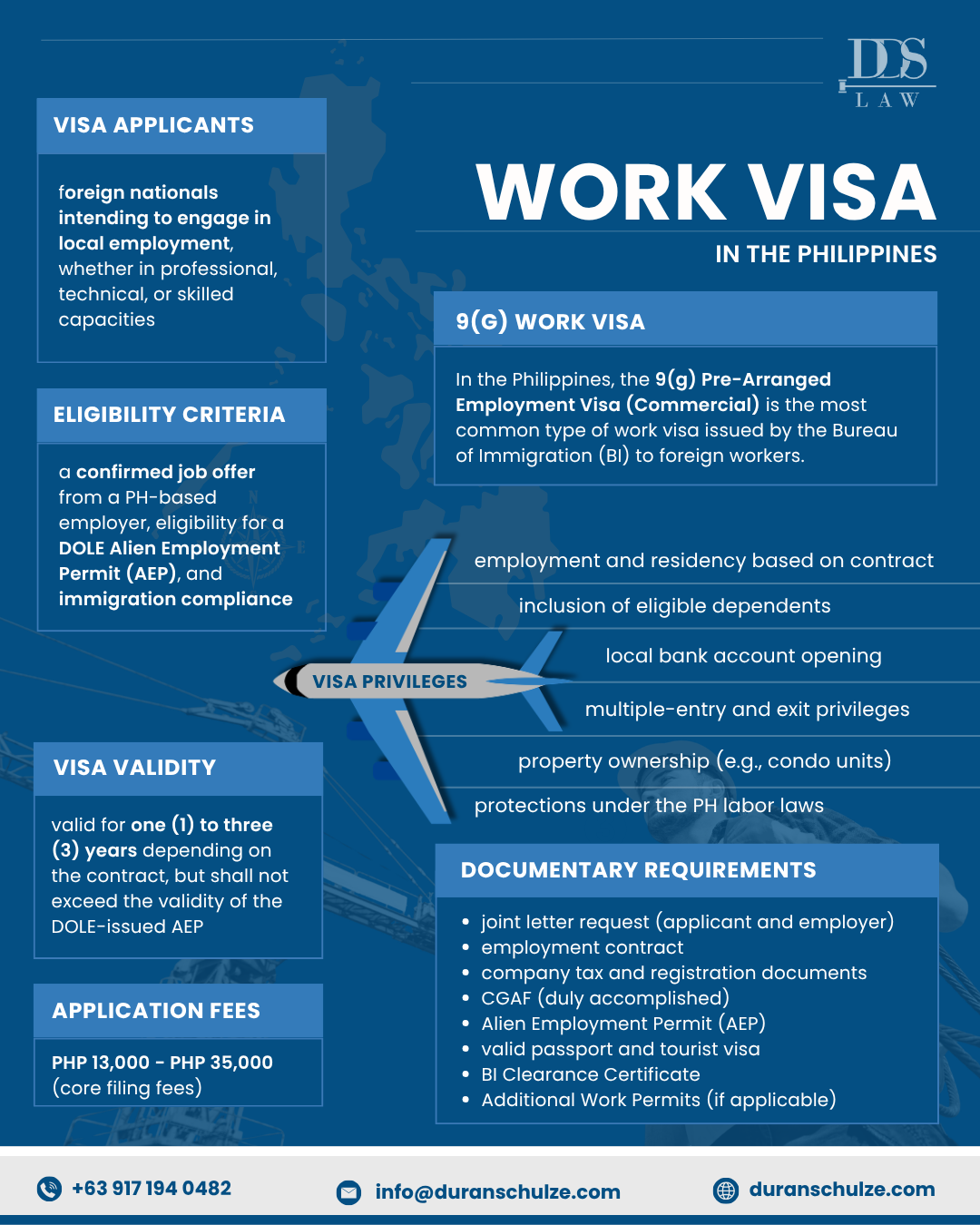
Between these two, the 9(g) Pre-Arranged Employment Visa, or simply known as the 9(g) Work Visa, is the most common type issued to foreign nationals pursuing lawful occupation, whether for wages, salary, or for other forms of compensation under legitimate employer-employee relations. 

9(g) Work Visa Eligibility: Foreign Applicants and Employers

Foreign nationals who intend to work in the Philippines, whether in professional, technical, or skilled roles, must have a confirmed job offer, relevant qualifications, and meet the requirements set by the Department of Labor and Employment (DOLE) and the Bureau of Immigration (BI). By law, the issuance of the work visa is anchored on: 

  1. The existence of an employer-employee relationship, where a locally registered company is willing to serve as the visa petitioner; 
  2. No local talent shows interest or is able to perform the role offered to the foreign employee; and,
  3. The foreign employee is engaged in a lawful occupation and receives compensation from the work, for which the visa is also strictly company and position specific.

On the other hand, the sponsoring employer must be a duly registered company in the Philippines, with a minimum paid-up capital of PHP 10 million, and must not be listed or restricted under the Foreign Investment Negative List (FINL)                       . 

9(g) Work Visa Benefits and Privileges

The 9(g) Work Visa holders in the Philippines are entitled to work and stay in the country for a duration approved by the Bureau of Immigration (BI), which also corresponds with the employment contract. While considered regular employees, they are also protected under Philippine labor laws, including wages, benefits, and workplace safety regulations. 

Visa holders may also make multiple entries and exits into and out of the county while the visa is valid. They may also open local bank accounts or purchase properties, such as condominium units, subject to foreign investment restrictions. 

Spouses and qualified dependents (e.g., unmarried children under 21 years of age) are also eligible to accompany the principal visa holders in the Philippines under dependent visas, but applications must still be processed separately.

9G Work Visa Application Requirements

To apply for a 9(g) Work Visa in the Philippines, both sponsoring employers and foreign applicants must prepare and submit the following documentary requirements: 

For Sponsoring Employers

  1. Joint letter request addressed to the Commissioner from the applicant and the petitioner
  2. Photocopy of Employment Contract, Secretary’s Certificate of Election, Appointment or Assignment of applicant, or equivalent document, with details of exact compensation, duration of employment, and comprehensive description of the nature and scope of the applicant’s position in the company
  3. Photocopy of petitioner’s latest Income Tax Return (ITR) with the corresponding proof of payment (official receipt, bank teller’s validation slip, BIR’s eFPS payment details printout, or other similar evidence)
  4. Securities and Exchange Commission (SEC) Certificate of Registration, Articles of Incorporation, and General Information Sheet (GIS) for the current year stamped received by the SEC (for corporations and partnerships)
  5. Department of Trade and Industry (DTI) Certificate of Registration of Business Name and Mayor’s Permit (for sole proprietorships)
  6. Actual publication of the applicant’s approved AP or, in the absence thereof, a Certificate of Publication issued by the Publisher
  7. Notarized certification number of foreign and Filipino employees from the petitioning company

For Foreign Employee-Applicants

  1. Duly accomplished Consolidated General Application Form (CGAF) for Non-Immigrant Visa
  2. Photocopy of passport bio-page and latest admission with valid authorized stay
  3. Photocopy of Alien Employment Permit (AEP) issued by the Department of Labor and Employment (DOLE) 
  4. Special Temporary Permit for an applicant practicing a regulated profession under the Professional Regulation Commission (PRC), if applicable
  5. Bureau of Immigration (BI) Clearance Certificate
  6. Original or certified true copy of Bureau of Quarantine Medical Clearance, if the applicant is a national of any of the countries listed under Annex “A” of Immigration Operations Order No. SBM-14-059-A who arrived in the Philippines on or after June 2014

For Dependents

  1. Duly accomplished Consolidated General Application Form (CGAF) for Non-Immigrant Visa
  2. Photocopy of passport bio-page and latest admission with valid authorized stay
  3. Proof of filiation with the applicant
  4. Bureau of Immigration (BI) Clearance Certificate
  5. Original and certified true copy of Bureau of Quarantine Medical Clearance, if the applicant is a national of any of the countries listed under Annex “A” of Immigration Operations Order No. SBM-14-059-A who arrived in the Philippines on or after June 2014

Before applying for the actual 9(G) Visa, foreign nationals must first secure an Alien Employment Permit (AEP) from the Department of Labor and Employment (DOLE) and a Special Temporary Permit (STP) from the Professional Regulation Commission (PRC) for the practice of regulated professions, if applicable. 

If required to work immediately while the work visa is being processed, the applicants should also apply for a Provisional Work Permit (PWP) from the Bureau of Immigration (BI). Typically, police clearance is also required and serves as proof that the foreign applicants do not have criminal records in their home countries. 

Duran & Duran-Schulze Law provides comprehensive 9(g) Work Visa application and renewal services in the Philippines and is duly accredited by the Department of Labor and Employment (DOLE) and the Bureau of Immigration (BI).

9G Work Visa Application Process (Step-By-Step Guide for Employers)

To provide a refined resource for our corporate clients, the following guide outlines the 9(g) Work Visa application process and emphasizes the employer’s role in ensuring full adherence to the joint regulations of the Department of Labor and Employment (DOLE) and the Bureau of Immigration (BI): 

1. Consult with Labor and Immigration Experts (Visa Service Providers). 

Before initiating a petition, employers must verify that the foreign national’s qualifications align with the specific requirements of the Philippine Labor Code. Comprehensive reviews of the sponsoring employer’s corporate standing, including business registration and capitalization, are important to prevent summary dismissals of the petition based on eligibility and documentary deficiencies. Consult Now >>>

2. Comply with Labor Market Test Requirements. 

In compliance with labor regulations, sponsoring employers must legally prove that no local workers are available, able, and willing to perform the roles of the foreign workers. This entails job vacancy publications on PhilJobNet, Public Employment Service Office (PESO), Job Placement Office (JPO), and other newspapers, as may be required, within the prescribed timeframes. 

3. Secure the Alien Employment Permit (AEP). 

An Alien Employment Permit (AEP), which is a mandatory prerequisite for the visa petition, must first be obtained from the Department of Labor and Employment (DOLE). Before filing, however, it is important to verify if the specific roles or applicants qualify for an exemption or exclusion under labor laws. While the application process typically takes weeks, early submission is critical.

4. Consolidate the Application Documents. 

Once the AEP is secured, the actual 9(g) Work Visa application may already be started by completing the Consolidated General Application Form (CGAF) and securing all other documents, including auxiliary ones, such as a Tax Identification Number (TIN), Provisional Work Permit (PWP), and Tourist Visa Extensions, if applicable. 

5. File the Application and Pay the Fees. 

Once all documents are complete, the visa application may already be submitted to the Central Receiving Unit (CRU) of the Bureau of Immigration (BI) or any of its authorized field offices. Upon the issuance of the Order of Payment Slip (OPS), all government fees must be settled to obtain the Official Receipt (OR) and the formal notice for the subsequent hearing. 

6. Attend the Scheduled Hearing.

Depending on the BI regulations, the employer’s authorized representative and the foreign nationals must appear before the Bureau of Immigration (BI) to testify to the veracity of the application. During this hearing, BI officers may ask for clarifications or supplemental documentation to support the company’s need for a foreign hire. 

7. Facilitate Biometric Capture and ACR I-Card Application.

Following a successful hearing, the foreign applicants must proceed to the Alien Registration Division (ARD) for image and fingerprint capturing. This is necessary for the processing of the Alien Certificate of Registration Identity Card (ACR I-Card), which serves as the foreign national’s official identification while working and residing in the Philippines.

8. Monitor the Visa Application.

Regular monitoring of the application through the Bureau of Immigration’s (BI) official website is essential. Applicants may also coordinate with a BI liaison officer or an accredited consultant to receive updates and help avoid processing delays. Also, it is advisable for foreign applicants to remain in the country for the duration of the process, as departure may necessitate additional revalidations. 

9. Wait for the Approval and Visa Implementation. 

Upon approval, the foreign national’s passport must be surrendered to the BI for the formal stamping or implementation of the 9(g) Work Visa and release of the physical ACR I-Card, at which point the employers and foreign workers should update their internal compliance records for future renewal cycles. 


The entire 9(g) Work Visa application processing, including the Alien Employment Permit (AEP) application, usually takes four (4) to six (6) months. 
9(g) Work Visa Validity, Extensions, and Renewals

The initial 9(g) Work Visa is typically granted for a duration of one (1) year, though extensions may be secured for subsequent terms of one (1) to three (3) years. To ensure continuous legal status, the employer must initiate the renewal process at least 60 days prior to expiration, as any lapse in validity subjects both the firm and the foreign national to substantial fines or deportation proceedings.

Additionally, the visa is strictly company-specific and tied to the original employment contract. Consequently, foreign nationals are prohibited from seeking concurrent employment with other entities. In the event of a resignation or termination, the employer is legally obligated to initiate a visa downgrade to a 9(a) Tourist Visa. Should the foreign national seek employment with a new firm, a new application process, including new AEP and 9(g) petitions, must be undertaken by the succeeding employer.

9(g) Work Visa Application Fees

Statutory requirements for 9(g) Work Visa applications begin with the Labor Market Test, involving mandatory newspaper publications and PhilJobNet postings that typically cost between PHP 4,000 and PHP 6,000. Additionally, employers should budget approximately PHP 20,000 for miscellaneous expenses, including official document requests, notarizations, and the administrative overhead required to secure auxiliary permits.

The core filing fees for the 9(g) Work Visa and the ACR I-Card range from PHP 13,000 to PHP 35,000, contingent upon the requested validity period of one (1) to three (3) years. These government costs are non-negotiable and must be settled at the time of application to secure the necessary hearing and biometric schedules.

Engaging professional service providers incurs additional fees ranging from PHP 50,000 to PHP 100,000, or even higher, depending on the complexity of the case and the inclusion of tourist visa extensions or provisional permits. However, this investment ensures expert troubleshooting of technical issues and comprehensive representation before regulatory bodies, significantly mitigating the risk of application denial.

Our 9G Work Visa Application and Renewal Assistance

As a visa and immigration services provider accredited by the Philippine Bureau of Immigration (BI), Duran & Duran-Schulze Law offers comprehensive 9(g) Work Visa application and renewal services. We serve as a strategic liaison between sponsoring employers, foreign nationals, and relevant regulatory bodies. We manage complex filings and timelines with both the Department of Labor and Employment (DOLE) and the Bureau of Immigration (BI), ensuring that initial applications and renewals are executed with precision.

For legal consultations and service inquiries regarding 9G work visa applications and renewals in the Philippines, call us at (02) 8478-5826 (landline) or +639171940482 (mobile), or email info@duranschulze.com.