





SEC Reportorial Requirements for Foreign Corporations (Branch Offices and Representative Offices) and Multinational Companies (Regional Operating Headquarters and Regional Headquarters)
Foreign corporations are entities formed under foreign laws that are granted a license to do business (Branch) or maintain a presence (Representative Office) within the Philippines. Additionally, Regional Operating Headquarters (ROHQ) and Regional Headquarters (RHQ) are branches of multinational firms that provide qualifying services or serve as administrative hubs for their affiliates in the region.
1. General Information Sheet (GIS)
The GIS for foreign entities monitors the local resident agent and the current standing of the head office. It must be submitted within thirty (30) calendar days from the anniversary date of the issuance of the SEC license, as mandated by the updated 2026 protocols.
2. Audited Financial Statements (AFS)
Foreign offices must disclose their financial position to ensure they maintain the required capital or assets for their license type. These must be submitted within 120 calendar days after the end of the fiscal year, generally reflecting the financial status of the Philippine operations.
3. Notification Update Form (MC 22-2014)
This unified form allows foreign corporations to report interim changes in their local operations without waiting for the annual GIS filing. It must be submitted within thirty (30) days from the occurrence of changes in the principal office address, accounting period, or resident agent.
4. Submission of E-Mail Addresses and Mobile Numbers (MC 28-2020)
Like domestic corporations, all foreign entities must also designate official electronic contact details via Annex D to receive formal SEC communications. This mandatory submission ensures that the SEC can effectively serve orders or notices to the foreign corporation’s local representatives.
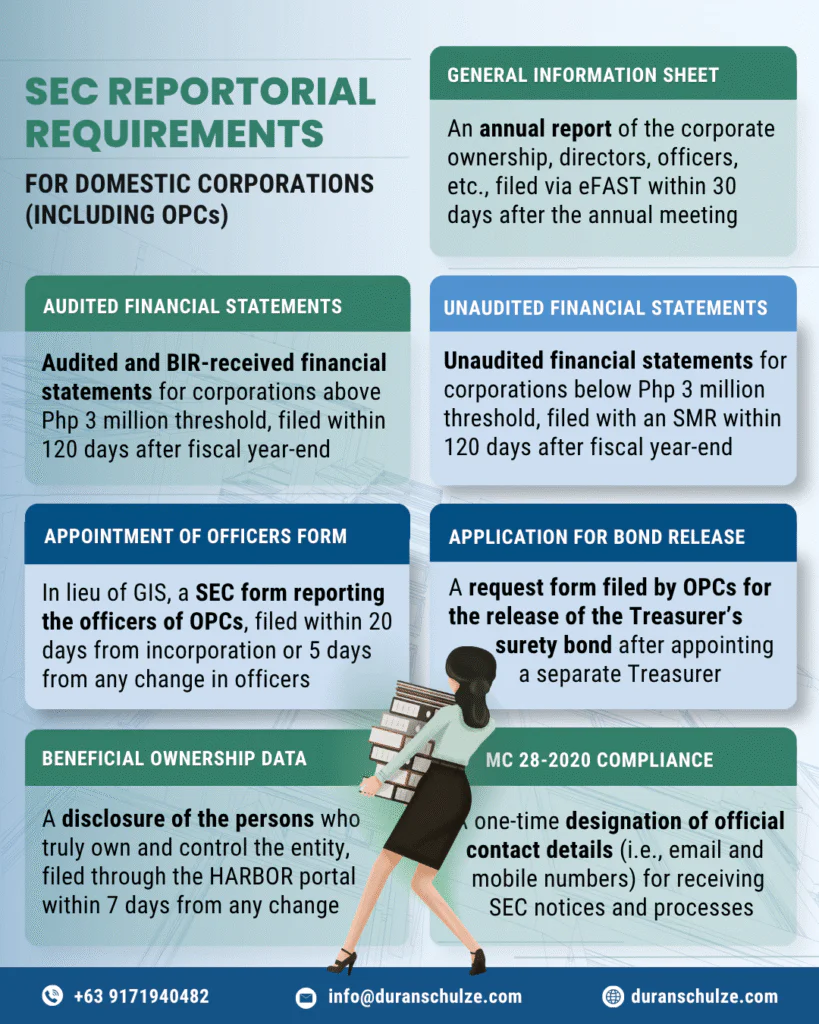
SEC Reportorial Requirements for Foundations
Foundations are non-stock, non-profit corporations established for charitable, religious, educational, or other public-benefit purposes.
1. General Information Sheet (GIS)
This document tracks the members and trustees who oversee the foundation’s fiduciary duties. It must be submitted within thirty (30) calendar days following the members’ actual annual meeting to ensure the SEC can monitor the foundation’s leadership.
2. Audited Financial Statements (AFS)
Foundations are subject to rigorous financial scrutiny to prevent the diversion of funds from their declared purpose. If following a calendar year, the deadline follows the SEC’s annual staggered filing schedule. For fiscal years, it is due within 120 days from the end of the period.
3. Non-Stock, Non-Profit Forms
Foundations must provide granular data on the utilization of their funds to maintain their tax-exempt status and operational legitimacy. These schedules and certifications from local government units or beneficiaries must be submitted concurrently with the AFS as part of the Non-Stock, Non-Profit Organization (NSPO) compliance package.
4. Submission of E-Mail Addresses and Mobile Numbers (MC 28-2020)
To facilitate monitoring, foundations must enroll their official contact information using Annex D. This ensures the SEC can provide timely digital notices regarding compliance and the entity’s non-stock, non-profit status.
SEC Reportorial Requirements for Corporations with Secondary Licenses
Highly regulated entities, such as banks and listed companies, require additional authorization to engage in activities like lending, investment, or public offerings.
To ensure market transparency, these corporations must file Annual Reports (SEC Form 17-A) and Quarterly Reports (SEC Form 17-Q), providing a detailed narrative of their operations and financial health. They must also submit Certificates of Attendance of Directors and Certificates of Independent Directors to verify that the board is active and meets statutory independence requirements for oversight.
Real-time disclosures must be maintained through the Current Reports (SEC Form 17-C), filed within five days of any material event that could affect stock prices. Furthermore, these entities must issue Information Statements (Preliminary and Definitive) to stockholders before meetings and, for specific sectors like mutual funds, submit Monthly Sales and Redemption Reports to track public fund movements.
For legal consultations and inquiries regarding compliance with SEC regulations in the Philippines, call us at (02) 8928-9535 (landline) or +639171940482 (mobile), or email info@duranschulze.com.