





In the Philippines, the Securities and Exchange Commission (SEC) is the primary registrar and overseer of the corporate sector. Beyond its issuance of Certificates of Incorporation, it maintains a rigorous oversight mandate to ensure market integrity, protect the investing public, and forestall fraudulent and unlawful practices. 

Central to the SEC’s reportorial requirements is the General Information Sheet (GIS). Far from a mere administrative formality, it is a critical instrument of transparency and a cornerstone of good corporate housekeeping.  

What is a General Information Sheet (GIS)?  

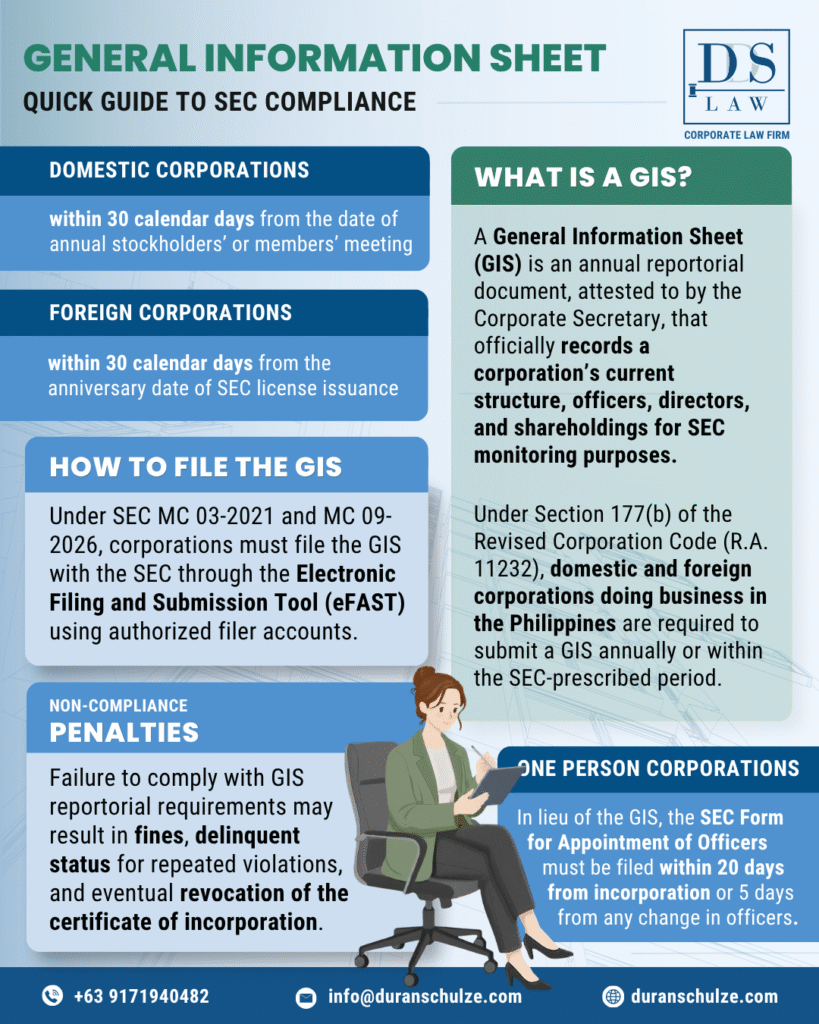
A General Information Sheet (GIS) is a comprehensive annual reportorial document that provides a definitive “snapshot” of a corporation’s current operational and ownership structure.   

Attested to by the Corporate Secretary, this document serves as the official record of a corporation’s directors, officers, and shareholding distribution, among other critical information, at a specific point in time. Thus, it is the primary medium through which the SEC monitors the judicial personality it has brought into legal existence.

Under Section 177 (b) of the Revised Corporation Code (R.A. 11232), which updated the decades-old Corporation Code of the Philippines, every corporation, domestic or foreign, doing business in the Philippines is mandated to submit a General Information Sheet (GIS) annually and within such period as may be prescribed by the SEC.

Sections of a General Information Sheet (GIS)

A General Information Sheet (GIS) is a granular document that requires precise data entry across several specialized sections and pages:

1. Basic Corporate Data

This section provides the registered corporate name, SEC registration number, principal office address, and contact information.

2. Business Classification and AMLA Compliance

This identifies the line of business and declares compliance with the Anti-Money Laundering Act (AMLA), specifically regarding Customer Due Diligence (CDD) and Know Your Customer (KYC) protocols.

3. Capital Structure

This presents a detailed breakdown of the authorized, subscribed, and paid-up capital, including the number of shares and their respective par values.

4. Governance and Management

This lists the members of the Board of Directors and Executive Officers, including their nationalities and Tax Identification Numbers (TIN).

5. Shareholder Profile

This discloses the top twenty (20) stockholders and their respective holdings.

6. Secretary’s Certification

This serves as a formal attestation, executed under oath and duly notarized, affirming the veracity of the information contained therein.

7. Beneficial Ownership Declaration

In line with global transparency standards, corporations must identify the “Beneficial Owner”—the natural person who ultimately owns or exercises effective control over the entity. (However, this is no longer included in the GIS upon the launch of the HARBOR system, where it is now being handled pursuant to SEC Memorandum Circular No. 15-2025). 

The latest and updated format in Microsoft Excel for a General Information Sheet (GIS) is available for download from the SEC official website.

Schedule of General Information Sheet (GIS) Filing

The schedule for GIS filing with the SEC is strictly construed based on the nature of the entity:

Stock and Non-Stock Corporations

The GIS must be filed within thirty (30) calendar days from the date of the actual annual stockholders’ or members’ meeting.

Foreign Corporations

The GIS must be filed within thirty (30) calendar days from the anniversary date of the issuance of the SEC license. 

One Person Corporations (OPCs)

In lieu of the standard GIS, an SEC Form for Appointment of Officers must be submitted within twenty (20) days after incorporation or five (5) days following any subsequent change in officers. 

How to File the GIS with the SEC

Pursuant to Memorandum Circular No. 03, Series of 2021 (MC No. 03-2021), the SEC now requires that reportorial requirements be filed exclusively through the Online Submission Tool (OST), which has since been rebranded as the Electronic Filing and Submission Tool (eFAST). This web-based system facilitates account creation for both individual corporations and their designated authorized filers.

While the eFAST platform remains accessible twenty-four (24) hours a day for uploads, the actual review, acceptance, and revision processes are conducted only from Mondays to Fridays. Consequently, any submissions made on a Saturday, Sunday, holiday, or during a work suspension are considered filed on the next working day.

To navigate this system, a corporation must utilize an eFAST Authorized Filer Account. This is an online profile maintained by an individual or entity specifically empowered through a board resolution or a sole owner’s resolution to handle the corporation’s filings. In this context, law firms, consultancy groups, and other professional service providers—such as Duran & Duran-Schulze Law Office—are permitted to enroll as authorized filers. Furthermore, these professional firms may be nominated by multiple distinct corporations to manage their collective reportorial compliance.

Per SEC Memorandum Circular No. 09-2026, the SEC accepts all reports filed through eFAST regardless of the number of reports to be filed with the Commission, while the responsibility for ensuring the accuracy and completeness of the reports lies with the filers or the authorized signatories. 

Despite this initial acceptance, reports may subsequently be reverted for various technical or substantive reasons. Common grounds for reversion include poor image quality (e.g., blurred or unreadable documents), incorrect page orientation, mismatched company profiles, or errors in the covered period and submission type. Critically, any reverted report is legally deemed “not filed” or “not received.” Once a reversion occurs, notifications are sent to the filers detailing the specific reasons for rejection, thereby necessitating a prompt re-submission to avoid potential penalties.

Our corporate compliance team at Duran & Duran-Schulze Law handles SEC filings and corporate amendments, applying Philippine corporate law to prepare accurate submissions, meet regulatory requirements, and ensure timely filing with the SEC.

Penalties for Non-Compliance with GIS Filing Requirements

Non-compliance with GIS reportorial requirements triggers pecuniary fines (currently based on SEC Memorandum Circular No. 6-2024) and may result in delinquency status and revocation of license. 

Late Filing Penalties

For domestic stock corporations, including One Person Corporations (OPCs), fines for late filing of the General Information Sheet (GIS) range from PHP 5,000 to PHP 45,000, depending on retained earnings, fund balance, or equity, and the number of offenses. For domestic non-stock corporations, fines range from PHP 5,000 to PHP 27,000.

For foreign stock corporations (e.g., branches, representative offices, and ROHQs), fines for late filing of the GIS range from PHP 10,000 to PHP 54,000, depending on accumulated income (AI), fund balance, members’ equity, and the number of offenses. For foreign non-stock corporations, fines range from PHP 5,000 to PHP 45,000.

Non-Filing Penalties

For domestic stock corporations, including One Person Corporations (OPCs), fines for non-filing of reportorial requirements (i.e., more than one year after the prescribed deadline) range from PHP 10,000 to PHP 54,000, depending on retained earnings, fund balance, or equity, and the number of offenses. For domestic non-stock corporations, fines range from PHP 10,000 to PHP 36,000.

For foreign stock corporations (e.g., branches, representative offices, and ROHQs), fines for non-filing of reportorial requirements (i.e., more than 60 days after the anniversary of the SEC license issuance) range from PHP 10,000 to PHP 90,000, depending on accumulated income (AI), fund balance, members’ equity, and the number of offenses. For foreign non-stock corporations, fines range from PHP 10,000 to PHP 54,000.

Delinquency Status

Under Section 177 of the RCC, the SEC is empowered to place corporations under delinquent status in case they fail to file their reportorial requirements (including the GIS) three (3) times either consecutively or intermittently, within five (5) years. 

Revocation of License

From the receipt of the Order of Delinquency issued by the SEC, corporations have six (6) months to file a petition to lift the order, otherwise resulting in the revocation of the Certificate of Incorporation and effectively dissolving the corporation’s legal existence (SEC Memorandum Circular No. 19-2023).
Best Practices for Maintaining GIS Compliance

In the current corporate regulatory climate in the Philippines, the Securities and Exchange Commission (SEC) has transitioned toward a highly digitized, almost zero-contact enforcement model that demands proactive oversight throughout the fiscal year. Here are some of the best practices that corporations can always adopt:

1. Adopting Strategic Corporate Governance

Strategic governance requires moving beyond reactive reportorial filing. By institutionalizing regular internal reviews, corporations can avoid the common technical errors that lead to reversions of submissions in the eFAST system. 

2. Maintaining an SEC Compliance Calendar

A standard compliance cycle for a corporation with a fiscal year ending December 31 typically follows a rigorous trajectory. It is important to note that while the GIS is an annual filing, beneficial ownership updates are now event-driven requirements that must be handled in real-time.

3. Empowering the Corporate Secretary or Compliance Officer

While the Corporate Secretary acts as the primary custodian of corporate records and the mandatory signatory of the GIS, a Compliance Officer may also be appointed to bridge the gap between board-level resolutions and regulatory submissions. 

GIS Compliance Frequently Asked Questions (FAQs)

For additional reference and guidance, here are some of the most frequently asked questions about compliance with the General Information Sheet (GIS) requirements: 

1. Who signs the General Information Sheet (GIS)?

The GIS must be signed and attested to by the Corporate Secretary, who assumes legal responsibility for the veracity of the information. However, for One Person Corporations (OPCs), the single stockholder or the appointed President signs the counterpart Appointment Form.

2. Does the GIS require notarization?

Yes, the GIS must be verified under oath, meaning the Secretary’s Certificate page must be duly notarized by a commissioned Notary Public before the scanned PDF version is uploaded to the eFAST system.

3. What happens if the annual meeting is not held?

If the annual meeting is not held on the date fixed in the Bylaws, the corporation must still file a “pro-forma” GIS no later than January 30 of the following year, indicating that no meeting was held. Once the meeting is eventually held, you then file a “New” or “Amended” GIS within 30 days of that actual meeting.

4. Is GIS filing required after a special meeting?

A new GIS is not necessarily required after every special meeting; however, if a special meeting results in material changes to the corporation—such as the election of a new director to fill a vacancy or a change in officers—an Amended GIS must be filed within seven (7) to thirty (30) days (depending on the specific nature of the change) to reflect the updated information.

5. Can the GIS be amended after filing?

Yes, an Amended GIS may be filed via the eFAST portal within thirty (30) days from the occurrence of any material change, such as the election of new directors, the resignation of an officer, or a change in the corporation’s principal business address.

6. Are partnerships required to file a GIS?

Partnerships are not obligated to file a GIS but are required to file an Amended Articles of Incorporation in case of changes in the structure and operations, such as a transfer to a new location. 

For legal consultations and service inquiries regarding compliance with the General Information Sheet (GIS) requirements and other SEC regulations in the Philippines, call us at (02) 8478-5826 (landline) or +639171940482 (mobile), or email info@duranschulze.com.