






In the Philippines, the legal framework for matrimony is anchored in the Family Code, which took effect on August 3, 1988, and superseded the pertinent provisions of the Civil Code on Marriage (R.A. 386). While marriage is an inviolable social institution governed by statutory mandates rather than private stipulations, the law provides a specific avenue for parties to exercise contractual autonomy regarding their economic union through prenuptial agreements.
Primarily, the purpose of prenuptial agreements is to establish financial autonomy, but they are also strategically utilized to mitigate risks associated with significant age disparities, substantial imbalances in wealth or indebtedness, and the complexities of blended families.
When prospective spouses enter into a prenuptial agreement, their property relations become legally defined by their express stipulations. Once validly executed, this agreement constitutes the primary law between them, effectively rendering the default statutory regimes of the Family Code merely supplementary and applicable to matters not explicitly covered.
This article provides a comprehensive guide for prenuptial agreements in the Philippines, examining their legal foundations under the Family Code, substantive prerequisites, and the procedures for drafting, execution, and registration.
What is a Prenuptial Agreement?
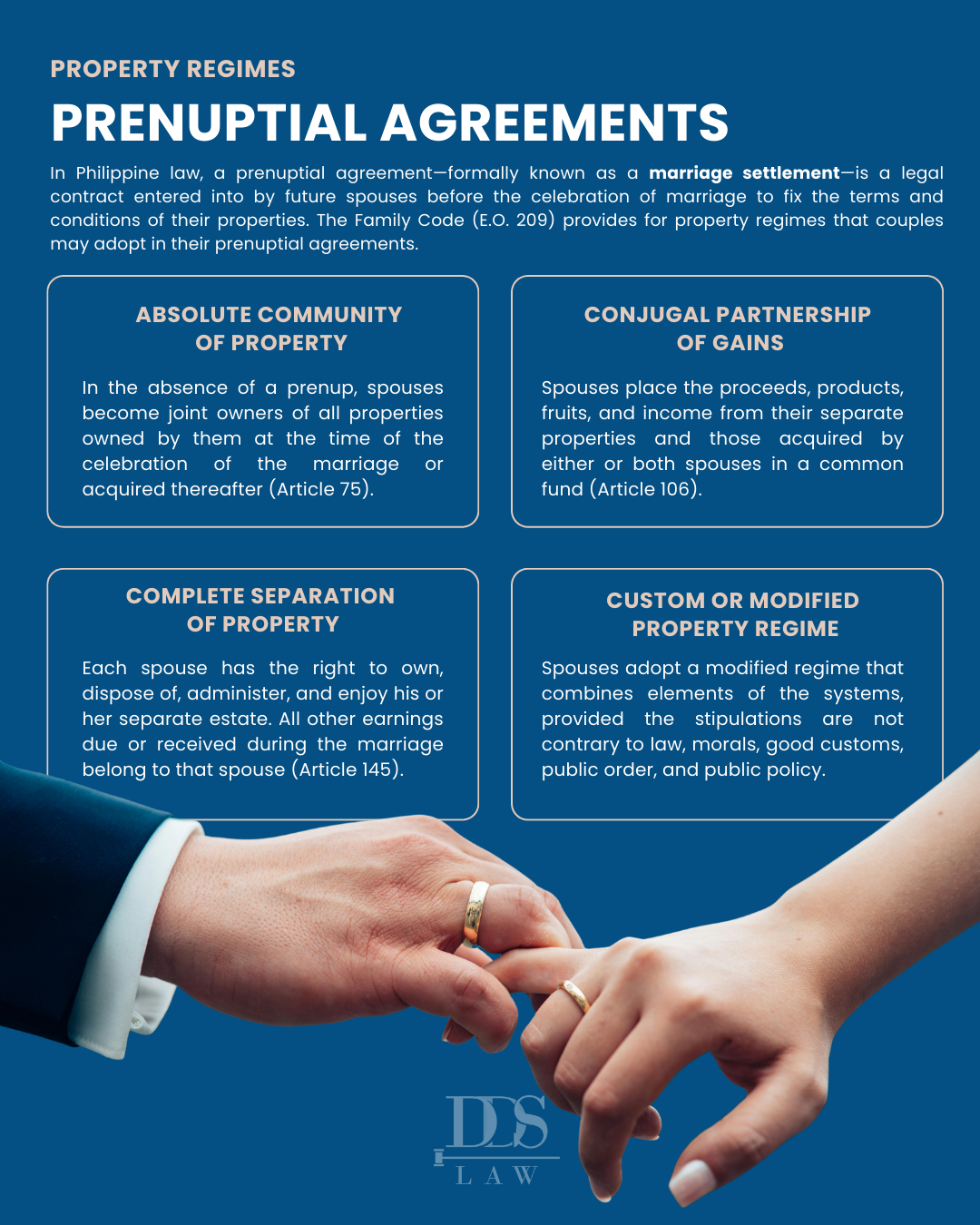
In Philippine law, a prenuptial agreement—formally known as a marriage settlement—is a legal contract entered into by future spouses before the celebration of marriage to fix the terms and conditions of their properties.
Legal Bases for Prenuptial Agreements in the Philippines
The legal framework for prenuptial agreements is primarily governed by the Family Code of the Philippines (Executive Order No. 209), which allows future spouses to dictate the rules governing their property relations, provided the stipulations do not contravene the law, morals, and public policy.
The Right to Contract Property Relations
The primary authority for prenuptial agreements is found in Article 75 of the Family Code, which recognizes the right of future spouses to enter into a marriage settlement and empowers the parties to select a specific property regime. In the absence of such a settlement or when the regime agreed upon is void, the Absolute Community of Property regime shall govern by default.
Mandatory Formalities and Registration
Article 77 mandates that the agreement be executed in writing and signed by both parties prior to the celebration of their marriage. Furthermore, the legal enforceability of the agreement against third parties is contingent upon its registration with the Local Civil Registry where the marriage is recorded, and in the relevant Registry of Deeds.
Immutability and Judicial Intervention
Under Article 76, the property regime becomes immutable once the marriage is celebrated, and any modifications must be finalized beforehand. Post-marriage changes cannot be made via any private contract and instead require a judicial decree, such as a judicial separation of property under Article 134.
Property Regimes to Adopt in Prenuptial Agreements
The Family Code also provides for specific regimes that couples may adopt, including:
Absolute Community of Property Regime
This is the default regime in the absence of a prenuptial agreement for marriages celebrated after August 3, 1988 (effective date of the Family Code). Under this regime, the spouses become joint owners of all properties owned by them at the time of the celebration of the marriage or acquired thereafter, as provided by Article 91. It also means that debts and liabilities incurred by one spouse may, under certain conditions, be charged against the entire community fund.
Conjugal Partnership of Gains Regime
In this regime, the spouses place the proceeds, products, fruits, and income from their separate properties and those acquired by either or both spouses in a common fund. Under Article 106, upon dissolution of marriage, the net gains or benefits obtained during marriage are then divided separately. Thus, it is preferred by those who wish to retain individual ownership of assets acquired prior to the marriage while sharing the fruits during their union.
Complete Separation of Property Regime
Under this regime, each spouse has the right to own, dispose of, possess, administer, and enjoy his or her separate estate. Pursuant to Article 145, all earnings from profession, business, or industry, and all fruits from separate properties, likewise belong to such spouse. This has become a common choice for those with significant pre-existing business interests who wish to maintain total financial independence and want to shield their assets from the liabilities of their spouse.
Custom Property Regime
Under Article 76, parties may also adopt a modified or customized regime that combines elements of the systems, provided the stipulations are not contrary to law, morals, good customs, public order, and public policy. For instance, a couple may agree on a separation of property for assets acquired before the marriage but choose a conjugal partnership for those acquired during the union.
General Prerequisites of Prenuptial Agreements
Based on the legal provisions of the Family Code and as discussed above, the following are the general prerequisites for the validity and enforceability of prenuptial agreements in the Philippines:
1. Written Instrument
A prenuptial agreement or marriage settlement must be executed in writing to be legally valid. This formal requirement ensures that the specific terms governing the couple’s property relations are clearly defined and preserved.
2. Capacity of the Parties
The parties must possess the legal capacity to contract marriage under the Family Code. This includes obtaining the necessary parental consent or advice where required by law; in such cases, the parents or persons exercising parental authority must also be made parties to the marriage settlement.
3. Ante-Nuptial Execution
The agreement must be executed prior to the celebration of the marriage. Any modifications or settlements attempted after the ceremony are void, unless with the intervention of a judicial decree.
4. Notarization Requirement
The agreement must also be duly notarized to qualify as a public instrument. Notarization is a practical necessity for the document to be accepted for further registration and to serve as prima facie evidence for its due execution.
5. Registration
For the agreement to bind third persons, it must be registered in the Local Civil Registry and the proper Registry of Deeds. Unregistered settlements are only binding between spouses and cannot prejudice the rights of third parties.