






In the Philippines, marriage must strictly comply with both essential and formal requisites prescribed by the Family Code (E.O. 209). These requirements ensure that the parties have the legal capacity and authority to marry and that the marriage is properly solemnized in accordance with the law.
While each requisite serves a distinct legal purpose, a marriage license is particularly important, and its absence may render a marriage void ab initio, however subject to specific exceptions provided by law. In such cases, the parties may seek a Declaration of Absolute Nullity of Marriage from the proper court.
What is a Marriage License?
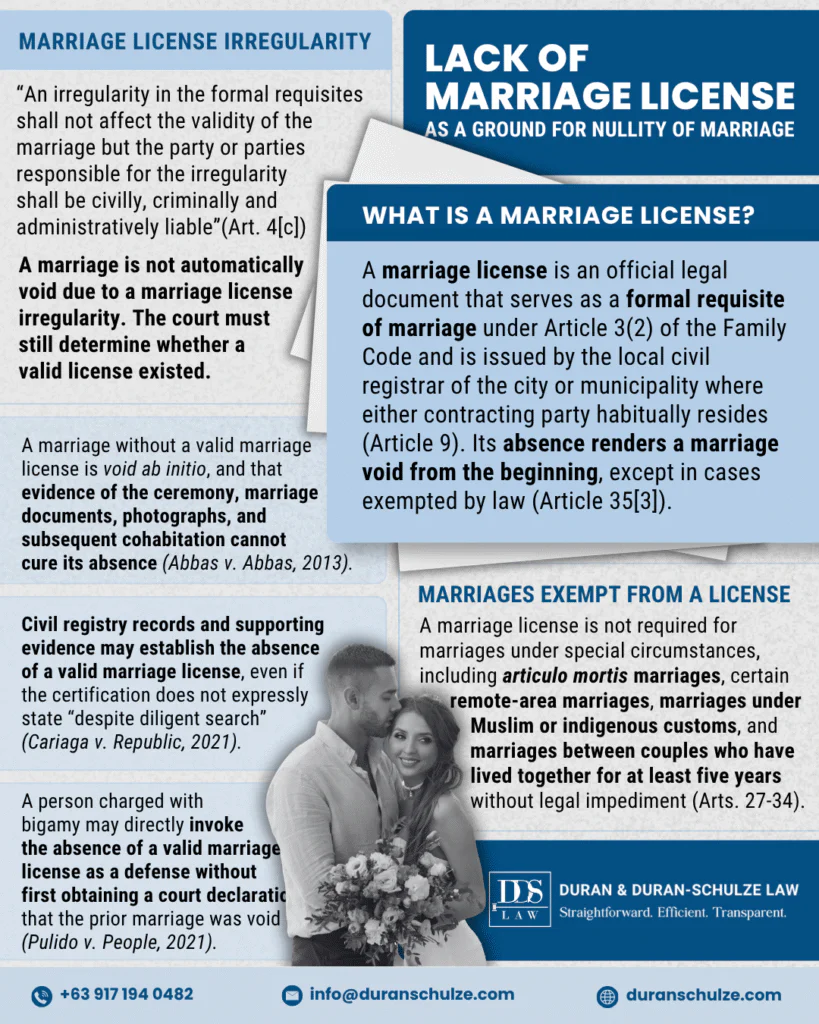
A marriage license is an official legal document issued by the local civil registrar or municipality where either contracting party habitually resides (Article 9, Family Code) and is a formal requisite of marriage (Article 3).
Under Article 11, each party must separately file a sworn application for a marriage license with the proper local civil registrar where required. To wit:
“Article 11. Where a marriage license is required, each of the contracting parties shall file separately a sworn application for such license with the proper local civil registrar which shall specify the following:
(1) Full name of the contracting party;
(2) Place of birth;
(3) Age and date of birth;
(4) Civil status;
(5) If previously married, how, when and where the previous marriage was dissolved or annulled;
(6) Present residence and citizenship;
(7) Degree of relationship of the contracting parties;
(8) Full name, residence and citizenship of the father;
(9) Full name, residence and citizenship of the mother; and
(10) Full name, residence and citizenship of the guardian or person having charge, in case the contracting party has neither father nor mother and is under the age of twenty-one years.
The applicants, their parents or guardians shall not be required to exhibit their residence certificates in any formality in connection with the securing of the marriage license.”
Generally, applicants for a marriage license must submit accomplished application forms, proof of birth or baptism, CENOMARs, valid government-issued IDs, photographs, and other documents required by the local civil registrar, such as proof of residency and community tax certificates when applicable. Additional requirements may vary depending on the parties’ circumstances and the local civil registry office.
Such additional requirements also depend on the parties’ age, citizenship, or previous marital status. These may include parental consent or advice, marriage counseling certificates, and, for foreign nationals, proof of legal capacity to marry and immigration documents. Applicants who were previously married may also need to submit proof of annulment, nullity, divorce, or the death of a former spouse.
Can Absence of a Marriage License Render a Marriage Void?
Yes, while a marriage license is a formal requisite of marriage, its absence renders a marriage void except in cases exempted by law (Article 35(3)).
Under the Family Code, a void marriage is one that is considered invalid from the beginning (void ab initio) because it failed to meet the essential or formal requisites of a valid marriage—as if it never legally existed. A Declaration of Absolute Nullity of Marriage, or simple nullity of marriage, is the appropriate judicial process by which a court formally declares such a marriage void.
What Marriages Are Exempt from a Marriage License Requirement?
Article 35(3) of the Family Code contains an important caveat: “except those covered by the preceding chapter.” Under Articles 27 to 34, a marriage license is not required in the following circumstances:
- When either of the contracting parties is at the point of death (articulo mortis);
- When the residence of either party is so located that there is no means of transportation to enable such party to appear personally before the local civil registrar;
- When the marriage is among Muslims or members of the ethnic cultural communities, provided they are solemnized in accordance with their customs, rites, and practices; or
- When the marriage is between a man and a woman who have lived together as husband and wife for at least five (5) years and without any legal impediment to marry each other.
What If There Was an Irregularity in the Marriage License?
In the context of the requisites of marriage, the terms “absence,” “defect,” and “irregularity” are three different legal concepts.
Under Article 4 of the Family Code, the absence of essential or formal requisites of marriage, which include a valid marriage license, makes a marriage void ab initio (i.e., declaration of absolute nullity of marriage), while a defect makes it voidable (i.e., annulment). An irregularity does not necessarily affect the validity of the marriage, although the parties involved may incur civil, criminal, or administrative liability.
“Article 4. The absence of any of the essential or formal requisites shall render the marriage void ab initio, except as stated in Article 35 (2).
A defect in any of the essential requisites shall render the marriage voidable as provided in Article 45.
An irregularity in the formal requisites shall not affect the validity of the marriage but the party or parties responsible for the irregularity shall be civilly, criminally and administratively liable.”
So it is clear that the mere fact that there was a problem with the marriage license does not automatically mean that the marriage is void. The court must determine whether there was no valid license at all or merely an irregularity concerning an otherwise existing marriage license.
How to Prove Absence of Marriage License in Nullity Cases
In nullity cases, a petitioner cannot merely allege the absence of a marriage license. As a formal requisite of marriage, its absence must be established by clear and convincing evidence, consistent with Supreme Court jurisprudence.
The Court has made clear that evidence of the marriage ceremony itself cannot cure the absence of a license. In Abbas v. Abbas, G.R. No. 183896 (January 30, 2013), the Court reiterated that a marriage solemnized without a valid marriage license is void ab initio under Article 35(3) and ruled that testimonial evidence showing a ceremony took place, signed marriage contracts, photographs, and subsequent cohabitation cannot supply or cure the absence of a required formal requisite like a marriage license.
More recently, the Court clarified how the absence of a license may be established through civil registry records. In Cariaga v. Republic, G.R. No. 248643 (December 07, 2021), the Court recognized that the absence of a marriage license may be established through the records of the local civil registrar. The Court held that a civil registry certification showing that the specified marriage license was issued to a different couple, together with supporting evidence, may sufficiently establish that no valid marriage license was issued to the parties, even if the certification does not contain the exact phrase “despite diligent search.”
Beyond civil actions for nullity, the absence of a marriage license carries critical implications in criminal prosecutions. In Pulido v. People, G.R. No. 220149 (July 27, 2021), the Supreme Court ruled that Article 40 of the Family Code—which states that “[t]he absolute nullity of a previous marriage may be invoked for purposes of remarriage on the basis solely of a final judgment declaring such previous marriage void”—applies only to civil remarriage. Because of this, a person on trial for bigamy can directly argue that a prior marriage was void from the start for lacking a marriage license without needing a separate court decree first. This allows the absence of a marriage license to be used directly as a defense to avoid criminal liability.
Final Thoughts
Clearly, lack of a valid marriage license can be a ground for declaring a marriage void ab initio under Article 35(3) of the Family Code, provided the marriage was not exempt from the license requirement and that the absence of the license is proven by clear and convincing evidence.
A petition for Declaration of Absolute Nullity of Marriage, however, remains a judicial proceeding, and the court—not the parties themselves—must determine whether the marriage is legally void.
Duran & Duran-Schulze Law (“DDS Law”) is a family law firm in Metro Manila, Philippines, specializing in declarations of nullity of marriage, annulments, legal separation, and recognition of foreign divorces. For legal consultations and inquiries, call us at (02) 8928 9535 (landline) or +639171940482 (mobile), or email info@duranschulze.com.