






Land buyers often mistakenly believe that signing a Deed of Absolute Sale (or any other deed of conveyance) immediately makes them the legal owners of the property. Truth is, a signed and notarized contract merely creates a personal obligation between the buyer and seller. It does not, on its own, transfer the land itself.
Under the Torrens System and Section 51 of the Property Registration Decree (P.D. No. 1529), true legal ownership is realized at the exact moment the transaction is inscribed in the public records of the Registry of Deeds (RD). Therefore, registration is the critical operative act that converts a private agreement into an absolute right over real property.
The legal weight of this system was solidified in the landmark rulings in Legarda v. Saleeby, G.R. No. L-8936 (October 02, 1915) and later reaffirmed in Republic v. Court of Appeals, G.R. No. 141145 (November 12, 2004), where the Supreme Court (SC) established that the primary purpose of the Torrens System is to quiet title to land once and for all, guarantee that a certificate of title is indefeasible, and serve as constructive notice to the entire world.
Equally, as affirmed in Castillo v. Escutin, G.R. No. 171056 (March 13, 2009), certificates of title prevail over tax declarations, which are mere administrative tools and possessory indicia, not conclusive proof of legal title unless anchored upon an authenticated certificate issued under the Torrens System.
Holding a physical deed, tax declarations, or even property receipts without securing a new Transfer Certificate of Title (TCT) leaves the property ownership vulnerable. Obtaining a new TCT issued in good faith is the only legal step under Philippine law that protects a buyer against third-party claims, fraudulent double sales, and unexpected encumbrances.
What is a Land Title?
A land title represents the abstract legal right of ownership over real property, whereas a Certificate of Title (e.g., a Transfer Certificate of Title issued under Presidential Decree No. 1529) is the official, tangible instrument that serves as conclusive proof of that right.
While Articles 427 and 428 of the Civil Code grant titleholders the full bundle of rights to possess, enjoy, and dispose of their property, it is the Torrens Certificate of Title that publicly guarantees and protects those rights against adverse claims. Jurisprudence strictly enforces this distinction to maintain the stability of the land registration system.
Documentary Requirements for Land Title Transfer
To process land title transfers in the Philippines, specific documentary requirements must be prepared and submitted at various stages.
- Deed of Conveyance (i.e., Deed of Absolute Sale (DOA), Deed of Extrajudicial Settlement of Estate (EJS), Deed of Donation (DOD), etc.)
- Certificate of Title (Original Owner’s Duplicate Copy and Certified True Copy (CTC))
- Latest Tax Declaration of Real Property
- Tax Clearance or Real Property Tax Certificate (RPT)
- BIR Tax Returns (i.e., BIR Form 1706 for Capital Gains Tax (CGT), BIR Form 2000-OT for Documentary Stamp Tax (DST), BIR Form 1800 for Donor’s Tax (DT), and BIR Form 1801 for Estate Tax (ET))
- Valid IDs and Taxpayer Identification Numbers (TINs) of the Buyer and Seller
- BIR Certificate Authorizing Registration (BIR eCAR)
- Proof of Tax Payments (i.e., CGT, DST, Transfer Tax, Registration Fees, etc.)
- Transfer Tax Clearance Certificate (TTC)
- Other Additional Documents, as may be necessary
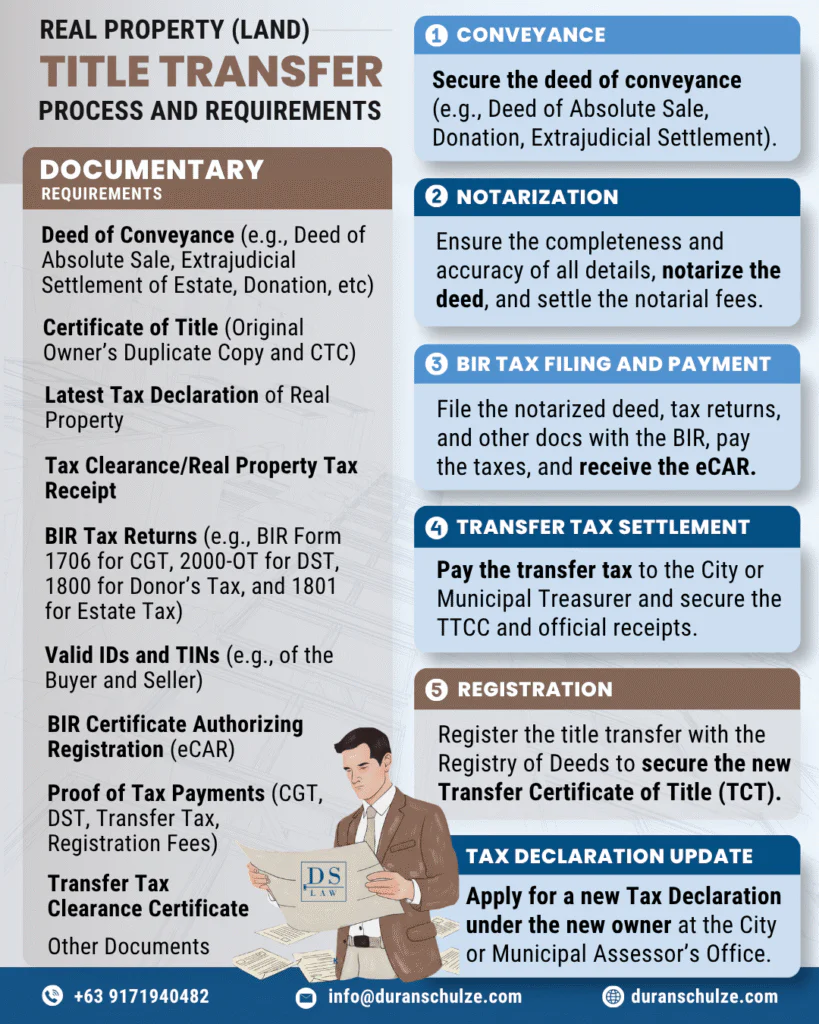
How to Transfer Land Titles in the Philippines
The land title transfer process involves several key steps, from preparing the deed of conveyance and paying the required taxes to registering the transfer and securing a new tax declaration.
1. Secure the Deed of Conveyance.
The transfer begins by drafting the legal instrument that transfers ownership, i.e., commonly a Deed of Absolute Sale (DOAS) for purchases, a Deed of Donation (DOD) for donations, and a Deed of Extrajudicial Settlement of Estate (ESJ) or Affidavit of Self-Adjudication (ASA) for inheritance.
Under Article 1358(1) of the Civil Code, contracts creating, transmitting, modifying, or extinguishing real rights over immovable property must appear in a public document. Thus, the drafted deed must explicitly detail the property’s technical description from the Transfer Certificate of Title (TCT), consideration amount, Tax Identification Numbers (TIN), and full details of both parties.
2. Notarize the Deed.
The parties must sign the instrument and execute an acknowledgment before a commissioned Notary Public, who records it in their Notarial Register.
Pursuant to Section 112 of the Property Registration Decree (P.D. No. 1529), notarization converts a private writing into a public document. This step binds third parties and serves as a statutory prerequisite for the instrument to be accepted by government agencies and the Registry of Deeds for registration.
3. Pay the BIR Taxes and Receive the eCAR.
Once the deed has been drafted and executed, submitting the documents for tax assessment, filing the tax returns, and payment of the taxes due at the appropriate Bureau of Internal Revenue (BIR) – Revenue District Office (RDO) should follow.
Under the National Internal Revenue Code (NIRC), as amended, this includes Capital Gains Tax (6% under Sec. 24(D)) or Creditable Withholding Tax for ordinary assets, alongside Documentary Stamp Tax (1.5% under Sec. 196). Upon compliance, the BIR issues an electronic Certificate Authorizing Registration (eCAR) under Revenue Regulations No. 3-2019, which serves as official proof that all national property transfer taxes have been settled.
4. Pay the Transfer Tax.
The notarized deed and BIR eCAR, among other documents, must then be presented to the Local Government Unit (LGU), specifically the City or Provincial Treasurer’s Office, for the payment of the transfer taxes.
Under Sections 135 and 151 of the Local Government Code of 1991 (R.A. 7160), the LGUs collect a local Transfer Tax rate capped at 0.50% in provinces or 0.75% in cities and Metro Manila, computed based on the selling price or zonal/fair market value, whichever is higher. After settlement, the treasurer will issue an Official Receipt and a Tax Clearance Certificate confirming full payment.
5. Register the Title Transfer.
The complete document bundle, which includes the Original Owner’s Duplicate Title, notarized Deed, BIR eCAR, LGU Tax Clearance, and Transfer Tax receipt, must be presented to the Registry of Deeds (RD) for recording of the transfer.
Governed by P.D. No. 1529 and Land Registration Authority (LRA) regulations, the Register of Deeds (RD) will verify the documents, process the registration fees (computed using the LRA’s graduated schedule), cancel the old owner’s duplicate TCT, and issue a new TCT registered in the buyer’s name under the Torrens System.
6. Apply for a New Tax Declaration.
Once the new Transfer Certificate of Title (TCT) is released by the Registry of Deeds (RD), the certified true copy of the new title and the notarized deed must be forwarded to the City or Municipal Assessor’s Office for issuance of a new Tax Declaration.
Governed by Section 203 of the Local Government Code (R.A. 7160), this administrative process cancels the seller’s old Tax Declaration and issues a new Tax Declaration in the transferee’s name for Real Property Tax (RPT) assessment purposes.
Duran & Duran-Schulze Law (“DDS Law”) is an estate and property law firm in the Philippines specializing in real estate transactions, land title transfers, inheritance and succession matters, and other property-related legal services. For legal consultations and inquiries, call us at (02) 8928-9535 (landline) or +639171940482 (mobile), or email info@duranschulze.com.