






Contrary to the widespread perception that absolute divorce is entirely unavailable and unrecognized under Philippine law, the Philippines recognizes divorce in two limited instances.
First, pursuant to the Code of Muslim Personal Laws of the Philippines (Presidential Decree No. 1083), absolute divorce (talaq) is legally recognized among Muslim Filipinos. However, its jurisdictional application is strictly circumscribed by Article 13 of the Code, which mandates that:
“(1) The provisions of this Title shall apply to marriage and divorce wherein both parties are Muslims, or wherein only the male party is a Muslim and the marriage is solemnized in accordance with Muslim law or this Code in any part of the Philippines.
(2) In case of marriage between a Muslim and a non-Muslim, solemnized not in accordance with Muslim law or this Code, the Civil Code of the Philippines shall apply.”
Second, a valid divorce decree obtained abroad between a Filipino citizen and a foreign national may also be recognized in the Philippines through a special judicial proceeding known as the Judicial Recognition of Foreign Divorce.
Judicial Recognition of Foreign Divorce
The judicial recognition of a foreign divorce is anchored on Article 26, paragraph (2) of the Family Code (Executive Order No. 209), which provides that:
“Where a marriage between a Filipino citizen and a foreigner is validly celebrated and a divorce is thereafter validly obtained abroad by the alien spouse capacitating him or her to remarry, the Filipino spouse shall have capacity to remarry under Philippine law (as amended by Executive Order 227).”
Although a literal reading of Article 26, paragraph (2) appears to confine its application to foreign divorces “obtained by the alien spouse capacitating him or her to remarry,” the Supreme Court (SC), in Republic v. Manalo, G.R. No. 221029 (April 24, 2018), clarified that the provision applies regardless of whether the foreign divorce was initiated or obtained by the alien spouse or the Filipino spouse. What is material is that the divorce validly dissolved the marriage under the applicable foreign law and capacitated the foreign spouse to remarry.
Equally significant, the scope of recognition is not confined to foreign divorce decrees issued by courts through judicial proceedings. It likewise encompasses valid non-judicial or administrative divorces, including those obtained by mutual agreement, as recognized by the Supreme Court in Republic v. Ng, G.R. No. 249238 (February 27, 2024).
Clarifying Foreign Divorces Between Two Filipino Citizens
From the foregoing discussion, the recognizability of a foreign divorce decree in the Philippines depends largely on the existence of a “foreign element” at the time the divorce is obtained.
Accordingly, a foreign divorce obtained between two Filipino citizens remains generally unrecognized and without legal effect in the Philippines pursuant to the Nationality Principle embodied in Article 15 of the Civil Code (Republic Act No. 386), which provides:
“Article 15. Laws relating to family rights and duties, or to the status, condition, and legal capacity of persons are binding upon citizens of the Philippines, even though living abroad.”
Now, a more complicated question arises when the foreign divorce involves Filipino dual citizens. Although the issue remains legally nuanced, Philippine courts have generally applied the Nationality Principle by treating the Filipino citizenship as controlling and disregarding the spouse’s additional foreign nationality for purposes of Article 26, paragraph (2). In the absence of a foreign spouse, a foreign divorce is generally viewed as an attempt to evade Philippine law and, therefore, is not entitled to judicial recognition.
Consequently, spouses whose marriages continue to subsist under Philippine law despite obtaining a divorce abroad must still avail themselves of the appropriate remedy under the Family Code, whether by filing a petition for declaration of nullity of marriage or a petition for annulment of a voidable marriage, as the circumstances may warrant.
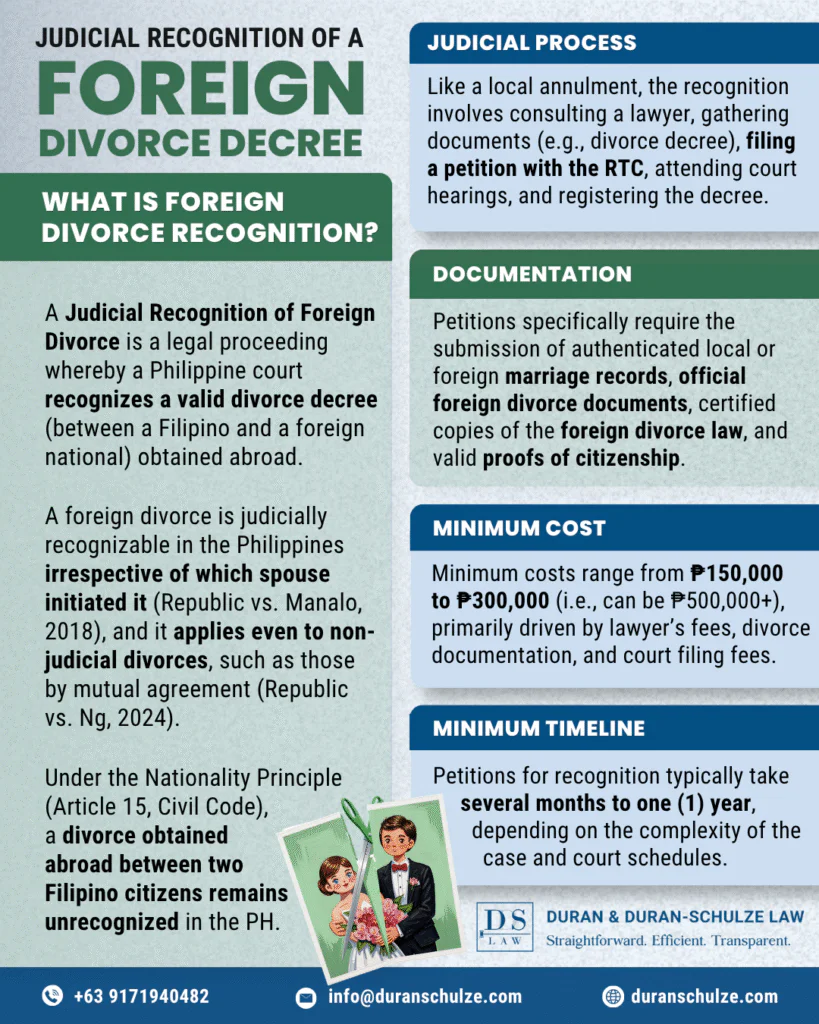
Requirements for Foreign Divorce Recognition
A petitioner seeking judicial recognition of a foreign divorce must establish the fact of the divorce. This requires proof of the foreign divorce decree or judgment, legally capacitating the foreign spouse to remarry.
As a general rule, petitions for judicial recognition of a foreign divorce are supported by authenticated copies of the parties’ marriage records, the foreign divorce decree or judgment, and competent proof of the parties’ citizenship. The documentary requirements, however, may vary depending on the foreign jurisdiction involved and the particular circumstances of the case.
Foreign-language documents need to be translated into English, certified by the appropriate foreign office, and apostilled or authenticated by the Department of Foreign Affairs (DFA) or the Philippine Embassy or Consulate in the foreign country.
Under the amended Rules of Court (A.M. No. 25-03-14-SC), Filipino spouses need only prove that the foreign divorce occurred, as proving the applicable foreign law is no longer required. The rules also presume that the divorce is absolute, that the foreign spouse is legally capable of remarrying, and that certified-under-oath English translations of divorce documents are accurate, unless contrary evidence is presented.
How to File for Recognition of Foreign Divorce in the Philippines
To file for a foreign divorce recognition, either spouse should engage a family lawyer to evaluate whether the foreign divorce legally qualifies for recognition under Philippine law, determine the documentary requirements, prepare and file the petition, and present the necessary evidence during court hearings.
The petition is generally filed under Rule 108 of the Rules of Court before the Regional Trial Court (RTC) having jurisdiction over the Local Civil Registry (LCR) where the marriage record is kept. Upon verifying its jurisdiction over the case and determining that the petition is sufficient in form and substance, the court will order the publication of the petition in a newspaper.
During court hearings, the Office of the Solicitor General (OSG) or public prosecutor may appear to represent the state’s interest and mandate in preserving marriage and ensuring that all legal requisites are met. Witness testimonies and other pieces of evidence must also be presented.
If the court finds that the legal requisites have been satisfactorily established, it will render a decision recognizing the foreign divorce. Once the decision becomes final and executory, the court will issue a Certificate of Finality.
The final judgment, together with the Certificate of Finality and other required documents, must then be registered with the appropriate Local Civil Registry (LCR) and the Philippine Statistics Authority (PSA) so that the recognition of the foreign divorce may be annotated on the marriage certificate.
The entire process typically takes several months to more than a year from the filing of the petition, depending on factors such as the complexity of the case, the completeness of the documentary evidence, the court’s docket, and compliance with publication and other procedural requirements.
Duran & Duran-Schulze Law (“DDS Law”) is a family law firm in BGC, Taguig, Philippines, specializing in petitions for recognition of foreign divorce. For legal consultations and inquiries, call us at +639171940482 (mobile) or email info@duranschulze.com.

![[Successful Case] Judicial Recognition of Foreign Divorce and Cancellation of Marriage Entry - Quezon City RTC](https://duranschulze.com/wp-content/uploads/2026/04/Successful-Case-Judicial-Recognition-of-Foreign-Divorce-and-Cancellation-of-Marriage-Entry-Quezon-City-RTC.webp)