





Unlike ordinary consumer purchases, which typically allow quick product inspections and offer simple post-purchase remedies such as returns and exchanges, real property purchases involve substantial financial commitments and legal complexities, thus requiring buyers and investors to exercise a heightened degree of caution and due diligence before entering into a transaction.
In a landmark case of Spouses Manalese vs. Estate of Ferreras, G.R. No. 254046 (11-25-2024), the Supreme Court affirmed that the “Mirror Principle” of the Torrens System is not an absolute shield for negligence, effectively redefining the standard of due diligence for real property buyers.
The Court upheld the lower court rulings voiding the property sale because of the titles obtained through fraud and further ruled that buyers must verify ownership by reviewing both the certificate of title and the records in the Registry of Deeds. “Since petitioners did not inquire into the register, and even without such inquiry, they are nonetheless constructively notified of every registration affecting the said subject properties, they cannot feign ignorance of such registrations,” said the Court.
This article provides a practical guide to conducting due diligence before a real property purchase in the Philippines and further examines its legal bases and importance.
What is Due Diligence in Real Property Transactions?
Due diligence refers to the careful and methodical examination carried out to confirm the accuracy of material information and assess potential risks before committing to a transaction or decision.
In real property transactions, due diligence involves systematic examination and verification of a property’s legal status, ownership, physical condition, and regulatory compliance, with the objective of confirming the seller’s authority to convey a valid title and of identifying risks inherent in the transaction.
Given that real property transactions in the Philippines are often burdened by issues such as flawed or forged titles, boundary and ownership disputes, unpaid real property taxes, and zoning or land-use violations—any of which may expose buyers to significant legal, financial, and regulatory risks—due diligence serves as a buyer’s primary proactive and risk-mitigating safeguard.
Legal Bases for Real Property Due Diligence in the Philippines
Due diligence in real property transactions is not governed by a single statute but rather a combination of civil law principles, property registration laws, tax regulations, and jurisprudential doctrines that collectively impose on buyers the duty to exercise prudence when acquiring real property:
Civil Code of the Philippines (R.A. 386)
The Civil Code provides the foundational legal framework for due diligence through its provisions on contracts, obligations, and sales. For instance, Article 1173 provides that an obligor is at fault or negligent upon failure to exercise diligence required by the nature of an obligation. When the law or contract does not specify the diligence to be observed, the standard is that of a “good father of a family” (bonus pater familias).
Property Registration Decree (P.D. 1529)
This decree governs the Torrens System, which operates on the “Mirror Principle,” where the certificate of title is supposed to reflect all facts about the property, including liens, mortgages, easements, and other restrictions. Purchasers are then considered to have constructive notice of all these entries and, with due diligence, can verify if a title is authentic, current, and free from encumbrances or annotations.
Realty Installment Buyer Act or Maceda Law (R.A. 6552)
This legislation protects buyers of residential real property acquired on an installment basis. Under Section 3, buyers who have paid for at least two (2) years are entitled, upon default, to a grace period for unpaid installments and, for a cancelled contract, a proportional payment refund, increasing with the length of installments. From a due diligence perspective, buyers must examine contractual terms against statutory protections.
Local Government Code of 1991 (R.A. 7160)
This law establishes the authority of the Local Government Units (LGUs) to assess and collect Real Property Taxes (RPT), enforce liens, and regulate land use. Under Article 257, for instance, the basic RPT and any other taxes levied constitute a lien on the property, which is superior to all liens, enforceable administratively or judicially irrespective of the owner, and can only be extinguished upon payment. Failure to pay RPTs may result in a Warrant of Levy (Section 258) and public auction of the property (Section 260).
Subdivision and Condominium Buyer’s Protective Decree (P.D. 957)
This cornerstone law protects buyers of subdivision lots and condominium units and establishes strict requirements for developers, such as the mandatory registration of projects with the Housing and Land Use Regulatory Board (HLURB), now integrated into the Department of Human Settlements and Urban Development (DHSUD), and the application for a License to Sell (LTS). Failure to conduct due diligence may expose buyers to risks such as the purchase of unregistered or illegal properties, unfinished projects, or defective units.
Risks of Buying Real Property Without Due Diligence
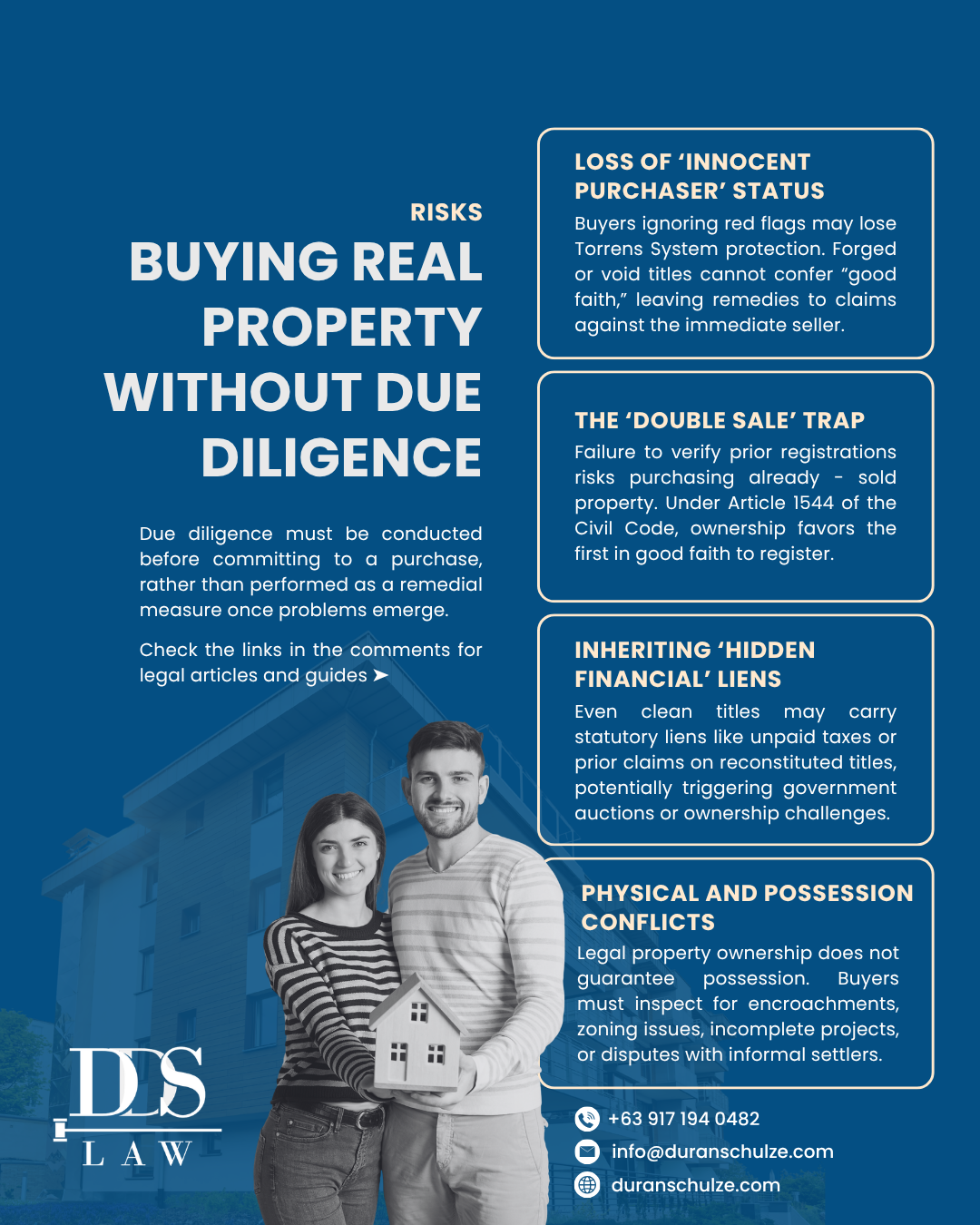
Due diligence should be completed before committing to a purchase, rather than performed as a remedial measure once problems emerge. Here are the top risks of buying real property without due diligence:
Loss of “Innocent Purchaser” Status
Failure to exercise due diligence can strip a buyer of the Torrens System’s protection. While the law generally safeguards reliance on a clean title (“Mirror Principle”), the Supreme Court, in Spouses Manalese vs. Estate of Ferreras, G.R. No. 254046 (11-25-2024), held that red flags require further investigation. If the seller’s title is forged or void, the buyer cannot claim “good faith,” and the true owner may seek reconveyance and cancellation of the title. The buyer’s remedy is to seek reimbursement from the immediate seller in a separate action.
The “Double Sale” Trap
Failing to conduct due diligence can also leave a buyer unknowingly purchasing a property already sold to someone else. Under Article 1544 of the Civil Code, ownership of immovable property is determined by who first registers the sale in good faith. If a prior buyer has already recorded an Adverse Claim or a Notice of Lis Pendens at the Registry of Deeds, and the new owner does not verify this, the Deed of Sale provides no legal protection.
Inheriting “Hidden” Financial Liens
Even when a title appears clean, certain statutory liens remain attached to the property regardless of ownership. Under the Local Government Code (LGC), unpaid Real Property Taxes (RPT) constitute a superior lien, allowing the government to auction the property to settle tax debts that remain unpaid for up to ten years. Similarly, recently reconstituted titles—issued to replace lost titles—are subject to a two-year reservation period, during which anyone with a prior interest may challenge ownership.
Physical and Possession Conflicts
Legal ownership of a real property does not automatically guarantee exclusive possession. Buyers who neglect physical inspections and relocation surveys risk encroachments, zoning and land-use violations, and incomplete projects. There may also be informal settlers, whose eviction under the Urban Development and Housing Act of 1992 (R.A. 7279), also known as Lina Law, can be lengthy, costly, and legally complex.