For many foreign nationals, what begins as a simple visit to the Philippines eventually becomes a long-term commitment to build a life with a Filipino spouse. Yet remaining in the country under a 9(a) Temporary Visitor Visa often results in an extended period of uncertainty—marked by repeated visa extensions, ongoing administrative obligations, and the practical limitations of being a perpetual “visitor” in a place that already feels like home.
To move beyond this state of limbo, many seek a more permanent immigration status through the 13(a) Spouse Visa, which offers more than a change in paperwork and visa classification. It provides legal stability, recognized residency, and a clearer framework for full integration into Philippine society.
This article serves as a comprehensive guide to the 13(a) Spouse Visa application process in the Philippines. It outlines the legal basis for the visa, eligibility requirements, required documentation, step-by-step application procedures, the transition from probationary to permanent residency, and ongoing obligations for maintaining visa status.
What is a 13(a) Spouse Visa?
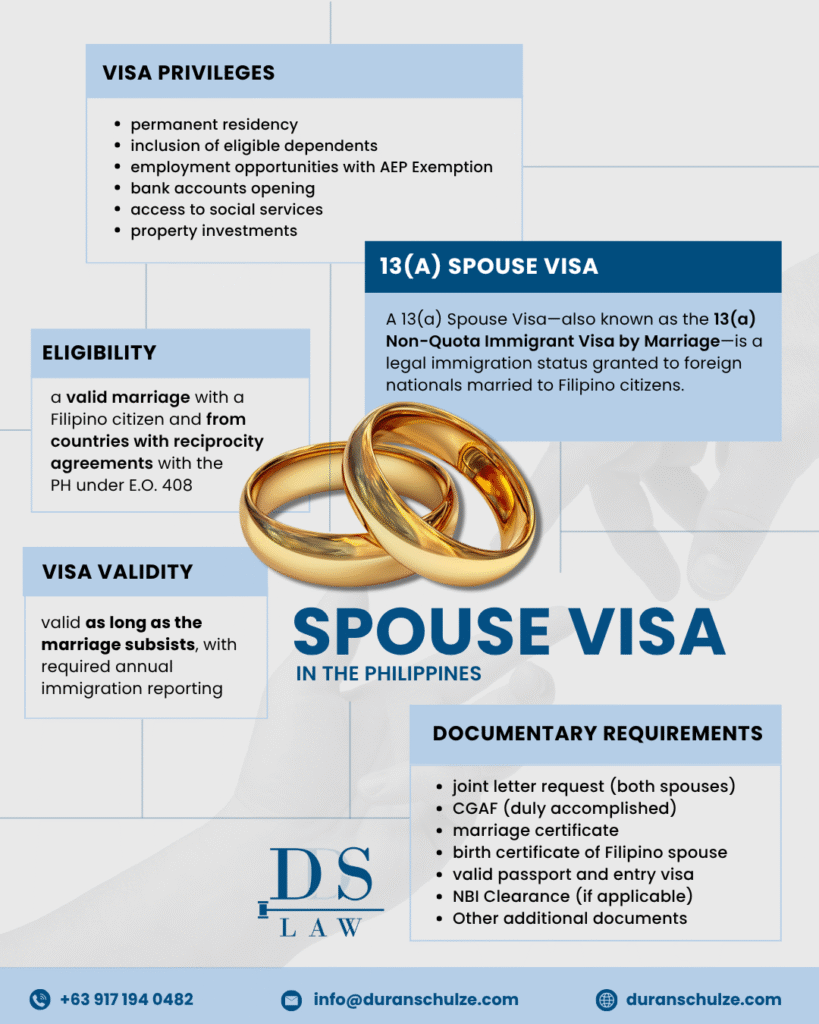
A 13(a) Spouse Visa—more formally known as the 13(a) Non-Quota Immigrant Visa by Marriage—is a legal status granted to foreign nationals married to Filipino citizens, authorizing them to stay, work, and live in the country with their spouses and dependents for an indefinite period of time.
Under Section 13 of the Philippine Immigration Act of 1940 (Commonwealth Act 613):
Sec. 13. Under the conditions set forth in this Act, there may be admitted into the Philippines immigrants, termed “quota immigrants” not in excess of fifty (50) of any one nationality or without nationality for any one calendar year, except that the following immigrants, termed “non-quota immigrants,” may be admitted without regard to such numerical limitations.
The corresponding Philippine Consular representative abroad shall investigate and certify the eligibility of a quota immigrant previous to his admission into the Philippines. Qualified and desirable aliens who are in the Philippines under temporary stay may be admitted within the quota, subject to the provisions of the last paragraph of Section 9 of this Act.
(a) The wife or the husband or the unmarried child under twenty-one years of age of a Philippine citizen, if accompanying or following to join such a citizen.
13(a) Spouse Visa Eligibility
To qualify for a 13(a) Non-Quota Immigrant Visa by Marriage, foreign applicants must demonstrate a valid marriage to a Filipino citizen recognized under Philippine law, a clean criminal record, financial self-sufficiency, and authorized entry into the jurisdiction. Interestingly, this privilege extends to unmarried children under 21 years of age as qualified dependents.
The visa eligibility, however, is strictly limited to nationals of countries that maintain reciprocity agreements with the Philippines or are listed under Executive Order (EO) 408. Applicants from certain jurisdictions, such as Egypt, Saudi Arabia, and Malta, may also be subject to specific gender-based or duration-of-marriage restrictions.
For nationals of non-reciprocal countries, alternative spouse visas such as the Temporary Resident Visa (TRV) or MCL-07-021 must be pursued. Furthermore, as Philippine law currently recognizes only opposite-sex marriages, same-sex unions—regardless of their legal validity in the applicant’s home country—do not satisfy the statutory requirements for a spouse visa.
13(a) Spouse Visa Benefits and Privileges
Primarily, the 13(a) Spouse Visa grants foreign spouses permanent residency in the Philippines for as long as the marriage with a Filipino citizen subsists without the need for visa renewals or extensions. Unmarried dependent children below 21 years of age are also entitled to derivative privileges under the same visa.
Additionally, visa holders may lawfully engage in employment upon securing only an AEP Certificate of Exemption. They may open local and foreign currency bank accounts and access other financial services. While no visa deposit or investment requirement applies, property investments are permitted, subject to applicable constitutional and statutory restrictions. Likewise, they are entitled to access education, healthcare, and other public and private sector services.
13(a) Spouse Visa Requirements
To initiate the application for a 13(a) Non-Quota Immigrant Visa by Marriage, foreign applicants must compile and submit the following documentary requirements:
For Foreign Spouses (Principal)
- Joint letter request addressed to the Commissioner from the applicant and the petitioning Filipino spouse
- Duly accomplished Consolidated General Application Form (CGAF) (BI Form CGAF-001-Rev 2)
- Marriage Certificate or Marriage Contract
- Birth Certificate or certified true copy of BI-issued Identification Certificate as Filipino citizen of the Filipino spouse
- Photocopy of passport bio-page and latest admission with valid authorized stay
- Valid National Bureau of Investigation (NBI) Clearance, if application is filed six (6) months or more from the date of first arrival in the Philippines
- Bureau of Immigration (BI) Clearance Certificate
- Original or certified true copy of Bureau of Quarantine Medical Clearance (if applicant is a national of any of the countries listed under Annex “A” of Immigration Operations Order No. SBM-14-059-A who arrived in the Philippines on or after June 2014)
- Other additional documents, as may be necessary
For Qualified Dependents
- Duly accomplished CGAF (BI Form CGAF-001-Rev 2)
- Photocopy of passport bio-page and latest admission with valid authorized stay
- Proof of filiation with the petitioner
- Valid NBI Clearance for each dependent 15 years of age or above, if application is filed six (6) months or more from the date of first arrival in the Philippines
- BI Clearance Certificate
- Original or certified true copy of Bureau of Quarantine Medical Clearance, (if applicant is a national of any of the countries listed under Annex “A” of Immigration Operations Order No. SBM-14-059-A who arrived in the Philippines on or after June 2014)
- Other additional documents, as may be necessary
13(a) Spouse Visa Application Process (Probationary)
The initial phase of the 13(a) Spouse Visa application process involves the conversion of the 9(a) Temporary Visitor Visa into a Probationary Resident Visa, contingent upon the fulfillment of statutory requirements. Upon approval, the Bureau of Immigration (BI) issues an Alien Certificate of Registration Identification Card (ACR I-Card), formalizing the applicants’ legal status.
1. Consult with Visa and Immigration Experts.
Given that visa categories vary by reciprocity and nationality—ranging from the standard 13(a) Spouse Visa to the Temporary Resident Visa (TRV) or MCL-07-021—it is imperative to engage visa and immigration experts. Consultations with them help ensure an accurate determination of visa eligibility, document preparation, and the mitigation of potential procedural hurdles.
2. Gather All Documentary Requirements.
The petitioning Filipino spouse and the foreign applicant must execute a Joint Letter Request and fill out the Consolidated General Application Form (CGAF). This filing must be supported by evidence of a valid marriage and the applicant’s good standing. Additional documentation must be prepared for each qualified dependent included in the petition.
3. File the Application with the Bureau of Immigration (BI).
While applications may be filed in person with the Bureau of Immigration (BI) or through the Philippine embassy or consulate in the home country, engaging BI-accredited visa service providers has become a standard practice to navigate bureaucratic complexities. Equally, professional representation minimizes the risk of application denials due to technical deficiencies.
4. Attend the Interview and Biometric Capturing.
Once the application is filed, the Bureau of Immigration (BI) typically requires the physical presence of both spouses to verify the authenticity of their marriage, residency claims, and the documents submitted. Simultaneously, foreign applicants must undergo biometric capturing for the ACR I-Card, the official regulatory identification while in the Philippines.
5. Pay the Fees.
Applicable government fees must be settled in accordance with the prevailing fee schedule released by the Bureau of Immigration (BI). Currently, principal applicants are assessed PHP 8,620, exclusive of the ACR I-Card fee, which is approximately US$ 50. For dependents, additional fees must also be paid (i.e., PHP 7,870 and PHP 8,370, depending on the age brackets).
Foreign applicants engaging BI-accredited visa service providers or legal counsel should anticipate additional professional fees. While the rates vary based on the service scopes (i.e., normally including expert guidance, document procurement, and administrative liaison), they typically range from PHP 50,000 to PHP 90,000.
6. Wait for the Approval and Issuance of the ACR I-Card.
Following the deliberative period, once the petition is granted via Agenda Approval, foreign applicants must surrender their passport for visa stamping. The process concludes with the issuance of the formal Order of Approval and the ACR I-Card.
In terms of the procedural timeline, the entire 13(a) Spouse Visa application typically spans two (2) to three (3) months from the initial submission of a complete documentary requirement to final visa implementation.