






A foreign tourist, as defined by the Department of Foreign Affairs (DFA), in the Philippines is “a person without distinction as to race, gender, language, or religion, who is proceeding to the Philippines for a legitimate, nonimmigrant purpose such as sightseeing, sports, health, family reasons, training or study (excluding enrollment in schools for the purpose of obtaining a title or degree), religious pilgrimage, business, cultural, and scientific purposes.”

9(a) Temporary Visitor’s Visa

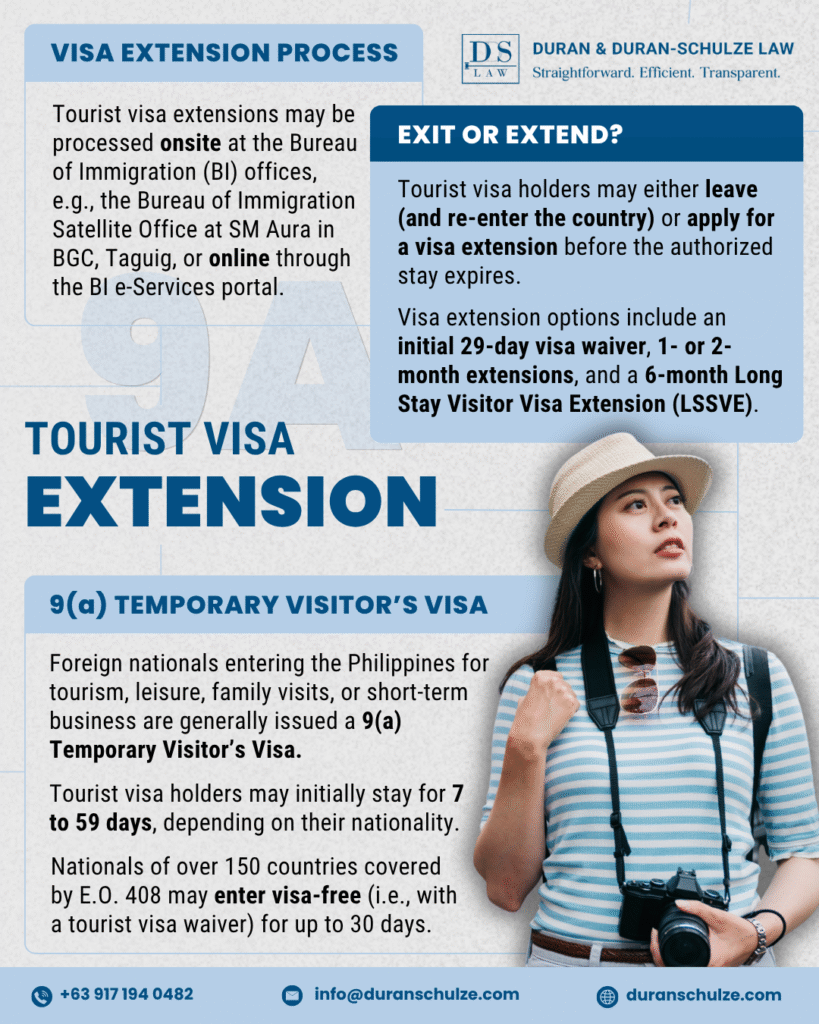
Upon entry for tourism, leisure, family visits, or short-term business, foreign nationals are issued a standard non-immigrant tourist visa, which is officially called a 9(a) Temporary Visitor’s Visa. 

Generally, temporary visitor’s visa holders entering the Philippines can initially stay for as short as seven (7) days or up to 59 days, depending on their nationality. 

However, foreign nationals from over 150 countries—including the U.S., UK, EU member states, Australia, Japan, and others covered under Executive Order (EO) 408—are allowed to enter the country visa-free for up to 30 days. Upon arrival, the immigration officer will stamp the passport with a Tourist Visa Waiver. The day of arrival is counted as Day 1, so a foreign national who enters the Philippines on September 27 may stay until October 27.

Philippine Tourist Visa Extension Options

Foreign nationals on tourist visas have two options before their authorized stay expires: they may either leave the country and re-enter to reset their permitted period of stay or apply for a visa extension. For visa extensions, below are the options: 

Initial 29-Day Visa Waiver

The Initial 29-Day Visa Waiver is an extension of the initial 30-day visa-free entry granted to eligible foreign nationals. While it is not a separate visa, it allows qualified tourists to remain in the Philippines for an additional 29 days, resulting in a stay of up to 59 cumulative days. 

Generally, foreign nationals who remain in the Philippines beyond 59 days are required to obtain an Alien Certificate of Registration Identity Card (ACR I-Card) in connection with subsequent visa extensions.

1-Month and 2-Month Tourist Visa Extensions

The 1-month and 2-month Tourist Visa Extensions are available for foreign nationals who wish to extend their stay in the Philippines beyond the initial 30-day visa-free period or the validity of the Initial 29-Day Visa Waiver. These extensions may be applied for successively, subject to compliance with the applicable immigration rules and regulations.

6-Month Tourist Visa Extension (Long Stay Visitor Visa Extension)

The 6-Month Tourist Visa Extension is available under the Long Stay Visitor Visa Extension (LSVVE) Program, which allows qualified foreign nationals to extend their authorized stay in the Philippines for six months in a single application, subject to the eligibility requirements and limitations prescribed by the Bureau of Immigration (BI). 

Under the program, non-visa-required foreign nationals may be granted a cumulative stay of up to 36 months, while visa-required foreign nationals may be granted a cumulative stay of up to 24 months.

Duran & Duran-Schulze Law (“DDS Law”) is a Bureau of Immigration (BI)-accredited visa processing agency and immigration law firm that assists foreign nationals with Philippine tourist visa extensions, other visa applications, and related immigration matters.

Tourist Visa Extension Fees

For non-visa-required foreign nationals, the applicable fees are PHP 3,030 for the initial 29-day visa waiver, PHP 4,400 for a one-month tourist visa extension, PHP 4,900 for a two-month extension, and PHP 11,500 for a six-month Long Stay Visitor Visa Extension (LSVVE).

For visa-required foreign nationals, the fees are PHP 4,400 for a one-month tourist visa extension, PHP 5,700 for a two-month extension, and PHP 13,900 for a six-month Long Stay Visitor Visa Extension (LSVVE). The 29-day visa waiver does not apply to visa-required foreign nationals (always check the official website of the Bureau of Immigration for updated fees). 

Tourist Visa Extension Requirements

A tourist visa extension application in the Philippines generally requires the submission of a duly accomplished Consolidated General Application Form (CGAF), a valid passport or travel document, a photocopy of the Downgrading Order (if applicable), and, in cases of overstaying, a notarized letter explaining the overstay together with the original or certified true copies of supporting documents.

Tourist Visa Extension Process (Online and Onsite)

Tourist visa extensions can be processed onsite at the Bureau of Immigration (BI) offices, e.g.,  the Bureau of Immigration Satellite Office at SM Aura in BGC, Taguig, or online through the BI e-Services portal. 

If processed onsite, regular processing is less expensive but requires the passport to be surrendered and claimed after approximately three to seven days. Express processing, on the other hand, may be completed within one day but comes at a higher cost.

During the processing, foreign tourists must bring their valid passport (at least six months of remaining validity) and any receipts from the previous extensions, if any, complete the Consolidated General Application Form (CGAF), and pay the corresponding fees. Once the application is approved, the passport may be claimed with the tourist visa extension stamp. 

If processed online, express fees automatically apply, making the application more expensive but generally faster and more convenient. However, the online portal may offer limited extension options, and technical issues may occasionally arise.

For legal consultations and service inquiries regarding tourist visa extensions in the Philippines, call us at (02) 8478-5826 (landline) or +639171940482 (mobile), or email info@duranschulze.com.